Brand Chemistry Test: Find Your Dominant Profile among the 5 Brand Personalities
Superior products and services often lose contracts, and not because the buyer made a bad call. They lose because a clearer, louder, more memorable brand got there first. When your brand personality is vague, the market defaults to comparing you on price.
It’s one of the most common (and most avoidable) patterns we see in B2B. So let’s talk about it properly.
The offer that should have won
Picture the scene. A company with years of expertise, a proven solution and a genuinely stronger offer walks into a procurement review. A competitor with a weaker product or service walks in right after, but with a story that fits on one slide.
Guess who gets the call back.
This isn’t a quality problem. It’s a perception problem. And once you fall into the commodity trap, comparison charts replace conversations, sales cycles stretch, and the discount becomes your main selling point.
Borrowed from Stanford, adapted in our lab
We’d love to say we invented a new way to look at brand personality. We didn’t, and we’re happy about it.
In 1997, Jennifer Aaker, now General Atlantic Professor of Marketing at Stanford Graduate School of Business, published a landmark study showing that people assign human personality traits to brands. Her research defined the 5 Dimensions of Brand Personality: Sincerity, Excitement, Competence, Sophistication, and Ruggedness.
Why build on research instead of taste? Because “I just don’t like that blue” is a very hard argument to win in a meeting. A framework with academic roots gives everyone, founders, CMOs and designers alike, something sturdier than opinions.
P.S. Yes, we know a branding agency turning a Stanford study into a chemistry set is a little on the nose. We’re keeping it.
Five profiles, five reactions
At Aquavita Solutions, we took Aaker’s model and turned it into a practical, reaction-based system: Aquavita Brand Alchemy.
Rather than forcing companies into rigid boxes, we look at the dominant profile driving a brand’s market perception. Most B2B companies align primarily with one of five core archetypes. Each holds a distinct advantage in the market, and each carries a subtle blind spot that silently costs deals.
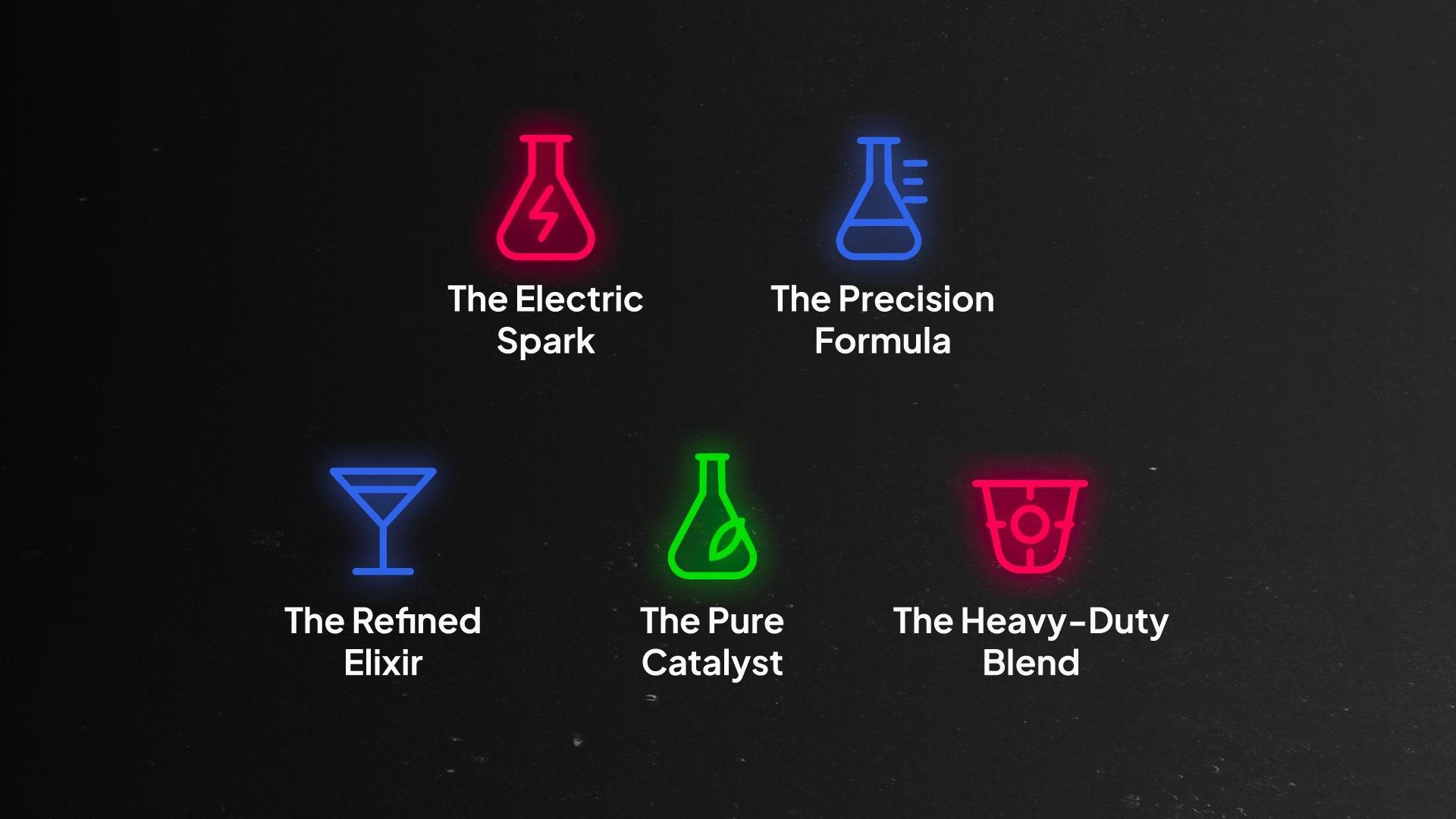
1. The Electric Spark (Aaker's Excitement)
Excitement belongs to brands seen as daring, spirited, imaginative and up-to-date, the ones that break category rules and make people curious before the pitch is over. It works best in launches and new categories, where being first (and a little loud) matters. Think Red Bull, Nike and Tesla.
The blind spot is structure: energy without structure is just fireworks, and buyers who notice you fast still need a reason to stay. You don’t need more ideas, you need a container to scale them.
2. The Precision Formula (Aaker's Competence)
The safe, institutional choice when failure isn’t an option: Competence describes brands seen as reliable, intelligent and successful. Data, rigor and flawless delivery win the room in regulated industries and enterprise procurement, wherever someone has to defend the decision to a committee. Apple, IBM and Volvo are the classic examples.
The blind spot is that when every sentence is a spec sheet, the story disappears, and price becomes the only conversation left. Reliability gets you hired, but your story makes you unforgettable, so lead with the outcome and let the specs back it up.
3. The Refined Elixir (Aaker's Sophistication)
Sophistication covers brands seen as upper class and charming. A Refined Elixir sells what choosing it says about you, which is why it thrives in premium, design-led categories where buyers pay for status, taste or exclusivity, not just function. Think Rolex, Chanel and Alfa Romeo.
The blind spot is distance: prestige can start to feel unreachable, and if the sales experience is colder than the brand promise, prospects look for someone warmer. Make it magnetic by removing friction from the moment someone tries to buy.
4. The Pure Catalyst (Aaker's Sincerity)
Sincerity stands for brands seen as down-to-earth, honest, wholesome and cheerful. A Pure Catalyst feels more like a partner than a vendor: clients stay, communities form around the mission, and trust becomes the deciding factor in long-term relationships. Patagonia, Dove and Ben & Jerry’s are the usual examples.
The blind spot is that being loved isn’t the same as being paid what you’re worth. Pure Catalysts often hesitate to ask for the deal, so the shift is to stay authentic and not be afraid to make some noise.
5. The Heavy-Duty Blend (Aaker's Ruggedness)
Less polish, more proof: Ruggedness is about brands seen as outdoorsy and tough. A Heavy-Duty Blend is built for the field and trusted for it, which is what buyers in industrial and operational markets value in something that has already survived real conditions. Think Jeep, Caterpillar and Yeti.
The blind spot is a perception gap: outstanding performance paired with dated visuals makes it hard to charge premium prices from a website that looks like a 2009 brochure. Built tough is great, but even steel looks better polished.
Strategy first, implementation second
A great logo can’t fix a positioning problem, yet most companies start there because a logo is easy to approve while a positioning decision has to be argued. But positioning is what tells the designer, the copywriter and the sales team what to do. Without it, every deliverable gets judged on taste, and “I just don’t like that blue” is back in the room.
When the strategy is clear, the rest follows:
Your sales pitch stops defending the price and starts framing the return.
Your visual identity signals authority and category leadership instead of just looking pretty.
Your brand voice cuts through the noise and speaks directly to the right decision-makers.
None of this is about making a company look bigger than it is. It’s about making sure the value you’ve already built is instantly obvious to the people who need it.
So, what's your chemistry?
By now you probably have a guess. Maybe two. (If you’re torn between the Precision Formula and the Heavy-Duty Blend, you’re in very good company.)
We built a 60-second Brand Alchemy test, grounded in Aaker’s Stanford model, to find out. Six real-world scenarios, no corporate vocabulary, no 40-page PDF waiting at the end. Just a clear read on your brand’s dominant profile and the strategic shift that could move it forward.
Until the next reaction
If your result sparks questions, or you’d like to talk about brand identity & strategy, presentation websites or communication materials, we’re only an email away at office@aqv.ro. We’d love to hear what you found.
Happy experimenting!